Miami, FL – September 3, 2025 — The City of Miami’s Economic Innovation &...





Miami, FL – September 3, 2025 — The City of Miami’s Economic Innovation &...

On May 28, 2025, the City of Miami and citizenM hosted a Tech Mixer. It was...

On May 7, 2025, the Opportunity Zones Policy Summit convened at the National...
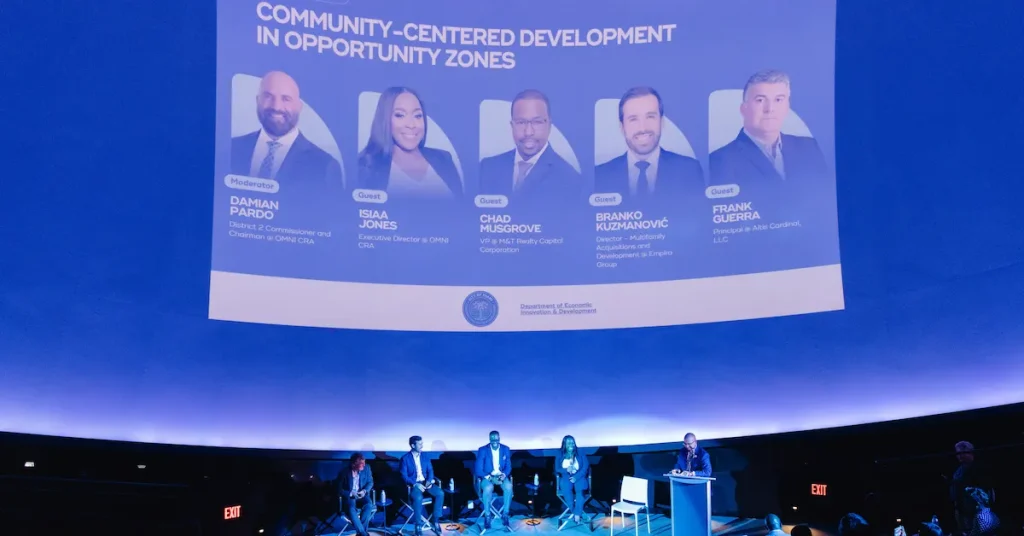
On April 11, 2025, the City of Miami’s Department of Economic Innovation and Development hosted the Opportunity Zone Summit at the Frost Museum of Science. A significant session was the panel discussion titled “Community-Centered Development in Opportunity Zones,” moderated by Damian Pardo, District 2 Commissioner and Chairman at Omni CRA. The panel featured Isiaa Jones, Executive Director at Omni CRA; Chad Musgrove, Vice President at M&T Realty Capital Corporation; Branko Kuzmanovic, Director of Acquisitions at Empira Group; and Frank Guerra, Principal at Atlas Cardinal LLC. They explored strategies for leveraging public-private partnerships, financial innovation, and CRA engagement to revitalize underserved communities through Opportunity Zones.
Damian Pardo kicked off the session by outlining its focus and introducing the panelists.
Damian Pardo
“Today’s discussion is going to explore public-private partnerships, financial innovation, and CRA engagement that can drive long-term inclusive impact for all.”
“Please join me in welcoming Isiaa Jones, the Executive Director of OmniCRA; Chad Musgrove, Vice President at M&T Realty Capital Corporation; Branko Kuzmanovic, Director of Acquisitions at Empira Group; and Frank Guerra, Principal at Atlas Cardinal LLC. Ask each of you to briefly share your background and explain how your work is connected to Community-Centered Development.”
The panelists then shared their roles and contributions to community development.
Isiaa Jones
“My name is Isiaa Jones. I’m the Executive Director of the City of Miami’s Omni Community Redevelopment Agency. How is our work connected to the community? We’re more connected to the community than city or county levels. We’re close to the stakeholders and local residents, ensuring citizens’ voices shape policy decisions and that plans are executed. When elected officials have an idea, we bring it to life. When there’s a need in the community, we execute and deliver results.”
Chad Musgrove
“I am Chad Musgrove, Senior Vice President with M&T Realty Capital Corp. We’re a subsidiary of M&T Bank, a top 15 bank in the country with over $200 billion in assets. I primarily work on our off-balance sheet side, providing Fannie Mae, Freddie Mac, HUD loans, permanent finance to developers after they’ve built these projects. How are we close to the community? Our work ensures liquidity in the market for safe, healthy housing. Fannie Mae and Freddie Mac are two of the largest issuers of financing for multifamily, much of which is affordable housing, both capital A and lowercase a, also known as workforce housing. We support seniors and manufactured housing.”
Branko Kuzmanovic
“My name is Branko Kuzmanovic. I’m a director of acquisitions for Empira Group. Empira Group is a multifamily development company in downtown Miami. We pursue opportunities to acquire sites across South Florida, primarily in Miami, to build multifamily housing. How we’re involved with the community is by identifying new areas in need of housing and quality developments, continuing to find opportunities to grow the city and different neighborhoods in Miami.”
Frank Guerra
“My name is Frank Guerra, principal with Atlas Cardinal, a ground-up multifamily developer throughout Florida. We’re based in Coral Gables. I was born and raised in Miami. How we impact the community as developers, when we go into Opportunity Zone areas, the focus of our panel today, we’ve built two projects. In both cases, it served as a catalyst for the surrounding area, with two, three, four other projects in the vicinity breaking ground as a result. Usually these Opportunity Zone areas are on the path of development, at the edge of a transitional area. It takes one to spur the second, third, fourth. The second way we impact the community is in the deals we’ve done, in addition to the Opportunity Zone metrics, we’ve partnered with a CRA or another group like the Penny for Pinellas program in Pinellas County to layer in income-restricted housing to address the missing middle issues and affordability challenges throughout most parts of Florida.”
Damian Pardo transitioned to a discussion on the role of Opportunity Zones in community-centered development.
What is an Opportunity Zone and why should developers and communities care?
Isiaa Jones
“My understanding of an Opportunity Zone is that it’s about vision, purpose, and opportunity. I start there because you’re revitalizing low-income areas to spur jobs, economic development, and revitalization within these districts. It’s a tool to defer capital gains. Where the CRA comes in, it’s a financing tool under Florida statute, and a number of other states have this funding mechanism. How do you capital stack to ensure a good product?”
Damian Pardo sought clarification on a financial term mentioned by Jones.
What is capital stack?
The panelists provided insights into financing mechanisms and the impact of Opportunity Zones.
Chad Musgrove
“Capital stack is the financing structure for a project. When developers like Atlas or Empira are developing or acquiring an asset, they need to finance that project. Leverage is involved, whether it’s a traditional lender like a bank or a private credit tool, and someone like myself steps in for the permanent finance. It’s a financing tool, depending on the structure of the deal and those Opportunity Zones. Are tax credits involved? Is there local equity from a quasi-public entity like the CRA? Do they have a project-based HAP contract or affordable vouchers at the property? It depends on what changes the financing. We’re all trying to get more supply into the marketplace to alleviate housing challenges.”
Branko Kuzmanovic
“On the equity side, it’s an opportunity to bring additional capital to other areas of the city and incentivize investors with a longer-term horizon to bring capital to areas that will provide housing and spur investment. Deferring capital gains allows groups to roll these gains into investments, committing to the neighborhood and area.”
Frank Guerra
“One of the unique aspects of the Opportunity Zone legislation, as opposed to most similar legislation, is that it’s incentive-based. It’s not writing a check; it counts on creating an incentive the development community and private community will capitalize on, spurring and accelerating development. You accelerate the timeline by creating that incentive. We need more of this legislation, and my understanding is that we are working on extending it.”
The “Community-Centered Development in Opportunity Zones” panel at the 2025 Opportunity Zone Summit offered a powerful vision for revitalizing underserved areas through strategic collaboration. Isiaa Jones underscored the importance of giving communities a voice, ensuring their needs drive policy and action. Chad Musgrove highlighted the critical role of financing in creating affordable housing, while Branko Kuzmanovic emphasized targeting neglected neighborhoods for quality development. Frank Guerra illustrated how Opportunity Zones can spark broader growth, accelerating progress in transitional areas. Together, their insights painted a clear picture: by harnessing public-private partnerships, financial innovation, and CRA engagement, cities like Miami can forge a path to inclusive, sustainable development, setting a model for urban renewal nationwide.